Choosing a lighting control system is not simply a matter of comparing two technical specifications.
A nightclub that needs fast color chases has very different requirements from an office that needs occupancy sensing, daylight harvesting and fault monitoring. Both projects may use LED lighting, but they should not necessarily use the same control protocol.
DMX and DALI are two of the most widely used digital lighting control systems. DMX is closely associated with stages, entertainment venues, façade lighting and programmable color effects. DALI is more commonly specified for offices, schools, hospitals, hotels and building lighting automation.
Neither system is universally better. The right choice depends on what the lighting needs to do after it is installed.
This guide explains the practical differences between DMX and DALI, including control speed, wiring, addressing, dimming, monitoring, installation and LED strip compatibility.
The Quick Answer: DMX or DALI?
Choose DMX when the project requires:
- Fast color changes
- Pixel-level animations
- Music-synchronized effects
- Stage or event lighting
- Dynamic façade lighting
- RGB, RGBW or addressable LED strips
- Frequent real-time control from a console or computer
Choose DALI when the project requires:
- Reliable architectural lighting control
- Individual fixture addressing
- Occupancy and daylight sensors
- Energy management
- Fixture-status feedback
- Scheduled lighting scenes
- Integration with a building management system
- Tunable-white office or hospitality lighting
For a hotel, shopping mall or mixed-use venue, it is also possible to use both: DALI for general lighting and DMX for decorative or entertainment lighting.

What Is DMX Lighting Control?
DMX stands for Digital Multiplex. The current DMX512-A standard is widely used to control entertainment lighting, color-changing fixtures, dimmers, moving lights and special effects.
A single DMX universe can contain up to 512 data slots, commonly called channels. Each channel carries a value from 0 to 255. A basic RGB fixture may use three channels, while an RGBW fixture normally requires at least four. More complex luminaires can occupy dozens of channels.
The ANSI E1.11-2024 standard specifies a typical bit rate of 250 kbit/s. With a complete 512-channel universe, the typical maximum refresh rate is approximately 44 updates per second. This is one reason DMX works well for responsive dimming, fast color transitions and live lighting effects.
DMX is often used with:
- Lighting consoles
- Art-Net or sACN nodes
- Standalone show controllers
- DMX decoders
- DMX address writers
- RGB and RGBW LED fixtures
- Direct-DMX addressable LED strips
- Moving heads and stage lights
For LED strip projects, a standard analog RGB or RGBW strip normally connects to a DMX decoder. A direct-DMX addressable strip can receive the DMX signal without a separate pixel decoder.
You can view the MSHLED DMX512 and SPI addressable LED strip range for examples of direct-DMX and programmable LED strip configurations.

What Is DALI Lighting Control?
DALI stands for Digital Addressable Lighting Interface. It is an internationally standardized system for communication between lighting-control devices.
DALI was designed primarily for architectural and building lighting rather than live entertainment. It allows lighting drivers, sensors, switches and application controllers to communicate over a two-wire bus.
A DALI-2 subnet can contain up to 64 control gear devices and 64 control devices. Control gear includes equipment such as LED drivers, while control devices include application controllers, occupancy sensors, light sensors and user-input devices. (Digital Illumination Interface Alliance)
DALI is bidirectional. A controller can send a dimming command to a driver and then query the driver for status information. Depending on the equipment, the system may report operating level, failure information, energy data or diagnostic data. (Digital Illumination Interface Alliance)
Each item of DALI control gear can store 16 scenes. Devices can also be addressed individually, as groups or by broadcast commands. This makes it practical to reconfigure zones through software without changing the lighting power circuits. (Digital Illumination Interface Alliance)
Typical DALI applications include:
- Offices
- Schools
- Hospitals
- Hotels
- Shopping centers
- Museums
- Public buildings
- Warehouses
- Emergency-lighting systems
- Building-management projects

DMX vs. DALI: Main Differences
| Feature | DMX | DALI |
| Main purpose | Entertainment and dynamic lighting | Architectural and building lighting |
| Typical applications | Stages, clubs, façades, events and pixel lighting | Offices, schools, hotels, hospitals and public buildings |
| Control style | Continuous channel data | Addressed commands, scenes and queries |
| Capacity | Up to 512 data slots per universe | Up to 64 control gear and 64 control devices per subnet |
| Communication | Primarily controller-to-device; RDM can add feedback | Bidirectional communication as a core feature |
| Speed | Suitable for fast, real-time effects | Intended for building-control commands and status data |
| Wiring topology | Terminated transmission line, normally daisy-chained | Free topology, including star and daisy-chain combinations |
| Termination | Required at the end of the DMX line | No DMX-style end terminator |
| Group control | Based on channel allocation and controller programming | Individual, group and broadcast addressing |
| Stored scenes | Usually stored in the controller or console | Up to 16 scenes stored in each item of control gear |
| Sensors | Possible through external control equipment | Standard part of DALI-2 systems |
| Monitoring | Limited with basic DMX; enhanced through RDM | Native two-way querying and feedback |
| Best LED strips | RGB, RGBW and addressable pixel strips | Single-color, tunable-white and DT8 color-control installations |
| Typical operator | Lighting technician or show programmer | Electrical contractor, integrator or facility manager |
DMX512-A defines a terminated differential transmission line and up to 512 data slots in one universe. DALI uses a polarity-free two-wire bus and allows flexible wiring topology, with a recommended maximum distance of 300 meters between the two furthest-apart devices when the specified cable and bus-current conditions are met.

1. Control Speed and Lighting Effects
The clearest difference appears when the lights start moving or changing color.
DMX repeatedly sends channel values to the connected fixtures. This continuous stream makes it well suited to live adjustments, chases, strobes, fades, pixel animations and music-synchronized lighting.
When a console fader moves, the fixture can react almost immediately. This is essential during concerts, theatrical performances and television production.
DALI works differently. It sends addressed commands such as:
- Turn on
- Turn off
- Fade to a specified level
- Recall a scene
- Change color temperature
- Report current status
That approach is efficient for building lighting, but DALI is not normally selected for high-frame-rate pixel animations.
A conference room does not need a rainbow chase running at dozens of updates per second. It needs the lights to fade smoothly when Presentation Mode is selected and to respond reliably to occupancy or daylight sensors.
Choose DMX for visual movement. Choose DALI for building behavior.
2. Addressing and System Capacity
DMX and DALI both use addressing, but the addressing methods are not the same.
DMX Addressing
Each DMX fixture is assigned a starting address. The number of channels occupied by the fixture is called its channel footprint.
For example, a basic RGBW fixture starting at address 1 might use:
- Channel 1: Red
- Channel 2: Green
- Channel 3: Blue
- Channel 4: White
The next four-channel fixture could begin at address 5.
A complete DMX universe supports up to 512 data slots. Larger projects use additional universes through a lighting console, Art-Net network or other Ethernet-based distribution system.
DALI Addressing
DALI assigns a short address to each device during commissioning. One DALI-2 subnet can support 64 control gear addresses and 64 control-device addresses.
The system can then control:
- An individual luminaire
- A group of luminaires
- Every luminaire on the subnet
- A stored scene
A single control-gear device can belong to several of the 16 available control-gear groups. (Digital Illumination Interface Alliance)
DMX capacity is therefore measured mainly in channels and universes. DALI capacity is measured in addressed devices and subnets.

3. Wiring and Network Topology
DMX is based on an EIA-485 differential data link. The preferred layout is a continuous line from the controller to the first fixture, then to the next fixture and so on.
The far end of the line should be terminated with the correct impedance to reduce signal reflections. The current DMX512-A standard specifies a 120-ohm terminator between Data+ and Data-. (tsp.esta.org)
Random passive star connections should be avoided unless an active DMX splitter is used.
A typical DMX chain is:
Controller → Fixture 1 → Fixture 2 → Fixture 3 → Terminator
DALI offers more freedom. The two-wire DALI bus can use:
- Daisy-chain wiring
- Star wiring
- Tree wiring
- A combination of these layouts
A closed-loop topology should not be used. The DALI bus carries communication data and bus power on the same pair of wires. That bus power is used for compatible control devices and communication electronics; it does not supply the main operating power for the luminaires. (Digital Illumination Interface Alliance)
The flexible topology is particularly useful in buildings where sensors, wall controls and drivers are distributed throughout multiple rooms.
4. Feedback, Diagnostics and Maintenance
Basic DMX control is mainly concerned with sending channel values to fixtures. The controller tells the light what to do, but a conventional DMX installation does not automatically provide detailed information about every fixture.
RDM, or Remote Device Management, can add bidirectional discovery, addressing and status functions to compatible DMX equipment. However, the console, distribution equipment and fixtures must all support the required functionality.
DALI includes bidirectional communication as a central part of the system. A DALI controller can query compatible control gear and obtain operating or diagnostic information.
DALI specifications can support standardized luminaire, energy and diagnostic data. This information can help facility managers identify failed lamps, abnormal operating conditions or equipment requiring maintenance. (Digital Illumination Interface Alliance)
This difference matters most after the project has been operating for several years.
A show technician can visually identify a failed stage fixture during setup. A facility manager responsible for thousands of office luminaires needs a system that helps locate faults without inspecting every room.
5. Dimming and Color Control
Both systems can dim LED lighting, but they approach dimming differently.
DMX Dimming and Color Control
DMX provides direct control of individual channels. It is therefore very flexible for:
- Single-color dimming
- Tunable-white control
- RGB color mixing
- RGBW color mixing
- RGBCCT lighting
- Moving-light parameters
- Addressable pixel effects
The exact number of channels depends on the fixture or decoder.
A direct-DMX RGBW strip may use four channels per pixel: red, green, blue and white. MSHLED’s 24V DMX programmable RGBW strip can receive a DMX512 signal directly and is suitable for programmable architectural and entertainment projects.

DALI Dimming and Color Control
DALI is well suited to smooth architectural dimming. DALI DT8 extends the system to standardized color control.
DALI-2 DT8 supports:
- Tunable-white control
- RGBWAF color control
- xy-coordinate color control
RGBWAF can control up to six color channels: red, green, blue, white, amber and a free-color channel. (Digital Illumination Interface Alliance)
DALI DT8 is especially useful in offices, healthcare spaces, hotels and museums where both intensity and white-light color temperature need to change during the day.
For wiring examples covering DALI DT8, RGBW and tunable-white strips, refer to the MSHLED LED strip wiring diagrams.
6. Sensors and Automated Lighting
DMX can be connected to sensors, time clocks and automation systems, but these functions are usually handled by external controllers, show-control software or building-system interfaces.
DALI-2 was developed with standardized control devices in mind. A DALI system can include:
- Occupancy sensors
- Daylight sensors
- Push buttons
- Rotary controls
- Scene panels
- Application controllers
- Bus power supplies
The application controller receives information from sensors and user controls, makes decisions and sends commands to the lighting drivers. (Digital Illumination Interface Alliance)
For example, a DALI office system can:
- Detect that someone has entered the room.
- Measure the available daylight.
- Raise the lighting only to the required level.
- Maintain a selected brightness during the working period.
- Dim or switch off the lights after the room becomes vacant.
DMX can produce a more dramatic lighting show. DALI can make a building react intelligently to everyday use.
7. Scenes and Daily Operation
A DMX scene is normally stored in a lighting console, software platform or standalone show controller. The scene can include hundreds of channel values, movements and timing cues.
This is ideal for programming:
- Concert cues
- Wedding lighting
- Club effects
- Holiday displays
- Building animations
- Product-launch shows
DALI scenes are stored in the control gear. Each item of DALI control gear can hold 16 scene values. One scene command can instruct multiple luminaires to move to their individually stored levels or colors. (Digital Illumination Interface Alliance)
A hotel conference room might use:
- Welcome
- Meeting
- Presentation
- Video Conference
- Cleaning
- Off
The lighting does not need to stream complex animation data. It only needs to recall the correct, preconfigured state.
8. Integration with Other Systems
DMX is frequently transported over Ethernet through protocols and products such as Art-Net or sACN. This allows many universes to travel across a network and be distributed to different lighting areas.
It also allows lighting software, media servers and show-control systems to synchronize visual effects.
DALI is commonly integrated with:
- KNX
- BACnet
- Building management systems
- Hotel room-control systems
- Emergency-lighting systems
- Energy-management platforms
- IP-based lighting networks
The DALI system usually controls the lighting drivers and sensors locally, while a gateway connects it to the larger building-control network.
DALI can also combine normal illumination and self-contained emergency lighting in one digital control environment, including compatible automated testing and reporting. (Digital Illumination Interface Alliance)
9. Installation and Commissioning
DMX commissioning usually involves:
- Planning the required universes.
- Assigning starting addresses.
- Setting fixture operating modes.
- Connecting the fixtures in the correct data-line topology.
- Installing termination.
- Patching the fixtures in the controller.
- Programming scenes, cues or effects.
- Testing the system under real operating conditions.
DALI commissioning normally involves:
- Installing DALI-compatible drivers and control devices.
- Connecting the two-wire bus.
- Confirming the bus power supply.
- Discovering the connected devices.
- Assigning short addresses.
- Creating lighting groups.
- Programming scenes and fade behavior.
- Configuring sensors and wall controls.
- Testing feedback and fault reporting.
- Saving the commissioning documentation.
DMX demands careful channel planning and show programming. DALI demands careful device commissioning and building-zone planning.
Neither system should be installed without a clear control schedule.

10. System Cost
It is difficult to declare DMX or DALI the cheaper system without looking at the project.
A simple DMX controller and decoder can be economical for a small RGB installation. A large live-production system with multiple universes, consoles, network nodes, splitters and backup control equipment can be expensive.
DALI normally requires compatible drivers, a bus power supply and commissioning equipment. Sensors, gateways and building-management integration increase the initial cost.
However, DALI may reduce long-term operating costs by supporting:
- Occupancy-based control
- Daylight harvesting
- Centralized maintenance information
- Software-based regrouping
- Automated testing
- Energy reporting
- Reduced unnecessary operating hours
The correct comparison is therefore not only the purchase price. Consider installation, programming, operation, maintenance and future system changes.
When Should You Choose DMX?
DMX is normally the better choice when lighting is part of the visual performance.
Choose DMX for:
Stage and Theater Lighting
DMX can control dimmers, moving lights, spotlights, RGB fixtures and other effects from one console.
Concerts and Events
Lighting cues can be synchronized with music, video and live performances.
Nightclubs, Bars and KTV Projects
DMX supports fast color changes, chases, strobes and sound-responsive scenes.
Dynamic Building Façades
Large areas of RGB or RGBW lighting can be divided into controllable zones or pixels.
Theme Parks and Attractions
Lighting can be synchronized with audio, video, mechanical equipment and scheduled shows.
Addressable LED Strip Projects
Direct-DMX or DMX-to-SPI control is useful when a project needs programmable running, chasing, gradient or pixel-mapping effects.
For these applications, explore the MSHLED addressable LED strip collection and DMX512 RGB pixel LED strip.

When Should You Choose DALI?
DALI is normally the better choice when lighting is part of the building infrastructure.
Choose DALI for:
Offices
Occupancy sensing, daylight control and scene selection can reduce unnecessary lighting while improving user comfort.
Schools and Universities
Classroom scenes can be configured for teaching, projection, examinations and cleaning.
Hospitals
Individual control, reliable dimming and monitoring are valuable in patient rooms, corridors and treatment areas.
Hotels
DALI can control room lighting, corridors, meeting rooms, restaurants and public spaces while integrating with hotel-management systems.
Retail Stores
Groups and scenes make it easier to change display lighting without rewiring circuits.
Museums and Galleries
DALI can provide carefully programmed dimming, tunable-white control and scheduled lighting for different exhibition areas.
Warehouses and Industrial Buildings
Occupancy and daylight sensors can control lighting in zones that are not continuously used.
Emergency Lighting
Compatible DALI systems can support automated emergency-lighting testing and reporting.

Can DMX and DALI Be Used Together?
Yes. In many large projects, combining DMX and DALI is more practical than forcing one protocol to perform every task.
Consider a hotel ballroom:
- DALI controls the normal white ceiling lighting.
- DALI sensors and keypads manage meeting and cleaning modes.
- DMX controls RGBW cove lights, stage fixtures and decorative wall washers.
- A central control interface recalls coordinated scenes across both systems.
Another example is a shopping mall:
- DALI controls tenant-area and corridor illumination.
- DMX controls seasonal decorations and media façades.
- The building management system supervises schedules and energy use.
- A gateway or central controller coordinates special events.
The two protocols do not normally connect directly to each other. A gateway, building controller or show-control platform is required to translate commands and coordinate the systems.
How to Choose Between DMX and DALI
Before selecting the protocol, answer these questions.
1. Does the Project Need Fast Animated Effects?
Choose DMX when rapid color changes, pixel animations or live control are essential.
2. Does the System Need Fixture Feedback?
Choose DALI when the facility team needs operating status, diagnostic information or centralized maintenance data.
3. Will Occupancy or Daylight Sensors Be Used?
DALI-2 provides a standardized environment for lighting sensors and application controllers.
4. Is the Lighting Part of a Live Performance?
DMX is the established option for stages, concerts, clubs and events.
5. Is the Lighting Part of a Building Automation System?
DALI is generally easier to integrate as a dedicated architectural-lighting subsystem.
6. Are RGB or Addressable LED Strips the Main Feature?
DMX is usually the stronger option for dramatic effects. DALI DT8 can control color, but it is generally chosen for architectural color and tunable-white applications rather than fast pixel animation.
7. Who Will Operate the System?
A trained lighting operator may prefer a DMX console. Office occupants and facility teams normally require automated DALI scenes, sensors and simple wall controls.
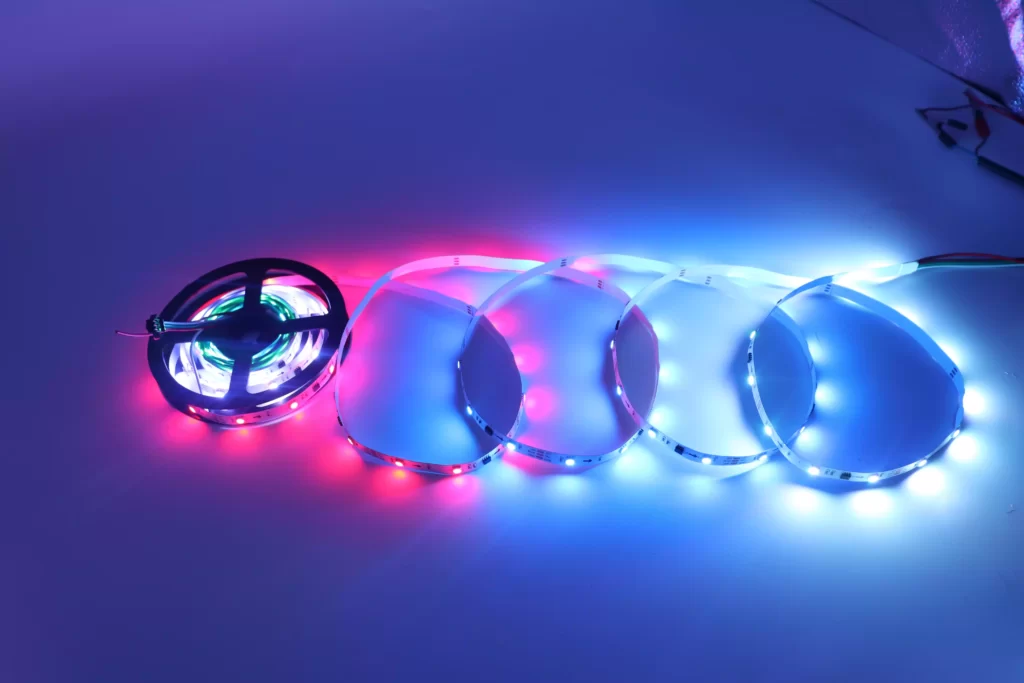
Using DMX and DALI with LED Strip Lights
The control protocol does not power the LED strip by itself. The strip still requires a correctly sized constant-voltage power supply or compatible LED driver.
DMX with Analog LED Strips
A single-color, tunable-white, RGB, RGBW or RGBCCT strip can connect to a compatible DMX decoder.
The system normally includes:
- DMX controller
- DMX decoder
- LED power supply
- LED strip
- Data cable
- Power wiring
DMX with Direct-DMX Addressable Strips
Some addressable strips include a DMX-compatible IC and can receive the DMX signal directly. An address writer may be required during commissioning.
The MSHLED direct-DMX RGBW strip includes separate power, address-writing and differential-data connections. (MSHLED)
DALI with LED Strips
A constant-voltage LED strip normally connects to a DALI-compatible LED driver or DALI PWM dimmer.
The driver must match:
- Strip voltage
- Total power
- Number of output channels
- Required dimming range
- Color-control method
For RGB, RGBW or tunable-white control, select a compatible DT8 device.
Before selecting the driver, calculate the LED load and provide suitable safety capacity. The MSHLED guide on choosing an LED strip power supply explains voltage and wattage selection.
For longer installations, a 24V LED strip can reduce current and voltage-drop problems compared with an equivalent 12V system.

Common Mistakes to Avoid
Selecting DMX for a Simple Office
DMX can dim office lighting, but it may create unnecessary programming and monitoring limitations when DALI would provide better sensor and feedback functions.
Selecting DALI for Fast Pixel Animation
DALI color control is useful, but it is not a replacement for a high-speed pixel or show-lighting controller.
Ignoring DMX Termination
An unterminated or poorly wired DMX line may cause flickering, unstable color or intermittent fixture response.
Creating Passive DMX Star Connections
Use a proper active splitter when the DMX signal must be divided into several branches.
Forgetting the DALI Bus Power Supply
DALI communication requires a correctly specified bus power supply. It is separate from the main power supplied to the LED drivers and luminaires.
Mixing Non-Compatible Drivers and Controllers
Confirm the protocol, voltage, output type, channel count and color-control mode before ordering equipment.
Failing to Save Commissioning Records
Keep a record of DMX addresses, DALI short addresses, groups, scenes, cable routes and controller settings.
Choosing a Controller Before Planning the Lighting
First determine the number of luminaires, strip type, pixels, channels, zones, scenes and operating requirements. Then select the controller.
For additional controller-selection information, read the MSHLED LED Controller: A Comprehensive Guide.

Final Verdict
DMX and DALI were developed for different lighting environments.
DMX is the stronger choice when lighting must react quickly, change color continuously or become part of a performance. It is ideal for stages, events, clubs, façades and addressable LED strip installations.
DALI is the stronger choice when lighting must operate as a manageable part of a building. It supports individual addressing, groups, stored scenes, sensors, feedback and integration with building-management systems.
The simplest decision rule is:
Use DMX when the lighting needs to perform. Use DALI when the lighting needs to manage a building.
For mixed-use spaces, use DALI for general and functional lighting, then add DMX for decorative, façade or entertainment effects.
MSHLED provides DMX512 addressable LED strips, RGBW LED strips, LED controllers and customized control solutions for architectural and entertainment projects.

Frequently Asked Questions
Is DMX Better Than DALI?
DMX is better for fast, dynamic and color-changing lighting. DALI is better for building lighting, sensors, energy management and equipment feedback. The project requirements determine which system is better.
Can DALI Control RGB Lighting?
Yes. DALI DT8 supports standardized RGBWAF color control, tunable-white control and xy-coordinate color control. The LED driver and controller must support the required DT8 color type. (Digital Illumination Interface Alliance)
Can DMX Control Normal White LED Lights?
Yes. A DMX decoder or compatible DMX driver can control single-color LED lights. DMX is not limited to RGB fixtures.
How Many Lights Can DMX Control?
One DMX universe supports up to 512 data slots. The number of fixtures depends on how many channels each fixture uses. Additional universes can be added for larger systems.
How Many Devices Can DALI Control?
One DALI-2 subnet can contain up to 64 control gear devices and 64 control devices. Larger installations use multiple DALI subnets connected through application controllers or gateways. (Digital Illumination Interface Alliance)
Does DALI Need Special Wiring?
DALI uses a two-wire bus. The wires are polarity-free, and free wiring topology is allowed. Cable sizing, routing and maximum distance must still follow DALI requirements. (Digital Illumination Interface Alliance)
Does DMX Need a Terminator?
Yes. The far end of a standard DMX data line should be correctly terminated to reduce signal reflections. The DMX512-A standard specifies a 120-ohm terminator between Data+ and Data-. (tsp.esta.org)
Is DALI Suitable for Stage Lighting?
DALI can control light levels and colors, but it is not normally chosen for live stage lighting or fast pixel effects. DMX is better suited to that environment.
Is DMX Suitable for Office Lighting?
Technically yes, but DALI is generally more practical when the office requires occupancy sensors, daylight harvesting, fixture feedback and building-management integration.
Can One Project Use DMX and DALI?
Yes. Many hotels, theaters, shopping centers and mixed-use buildings use DALI for functional lighting and DMX for decorative or entertainment lighting.
What Is the Difference Between DMX and DALI Wiring?
DMX normally uses a terminated line or daisy chain. DALI allows star, tree and daisy-chain layouts, provided a closed loop is avoided and system limits are respected.
Can DALI Control LED Strip Lights?
Yes. Connect the LED strip to a compatible DALI constant-voltage driver or PWM dimmer. The driver must match the strip voltage, wattage and number of color channels.
Can DMX Control Addressable LED Strips?
Yes. A DMX-to-SPI decoder can control compatible SPI strips, while a direct-DMX addressable strip can receive DMX data without a separate pixel decoder.
What Is DALI-2?
DALI-2 is the certification program that improves device interoperability and includes standardized control devices such as sensors and application controllers. Certified products are listed in the DALI Alliance product database. (Digital Illumination Interface Alliance)
Which System Is Easier to Maintain?
DALI often provides better maintenance support because it can query compatible drivers and report status or diagnostic information. DMX systems can gain management functions through RDM, but all connected equipment must support it.